








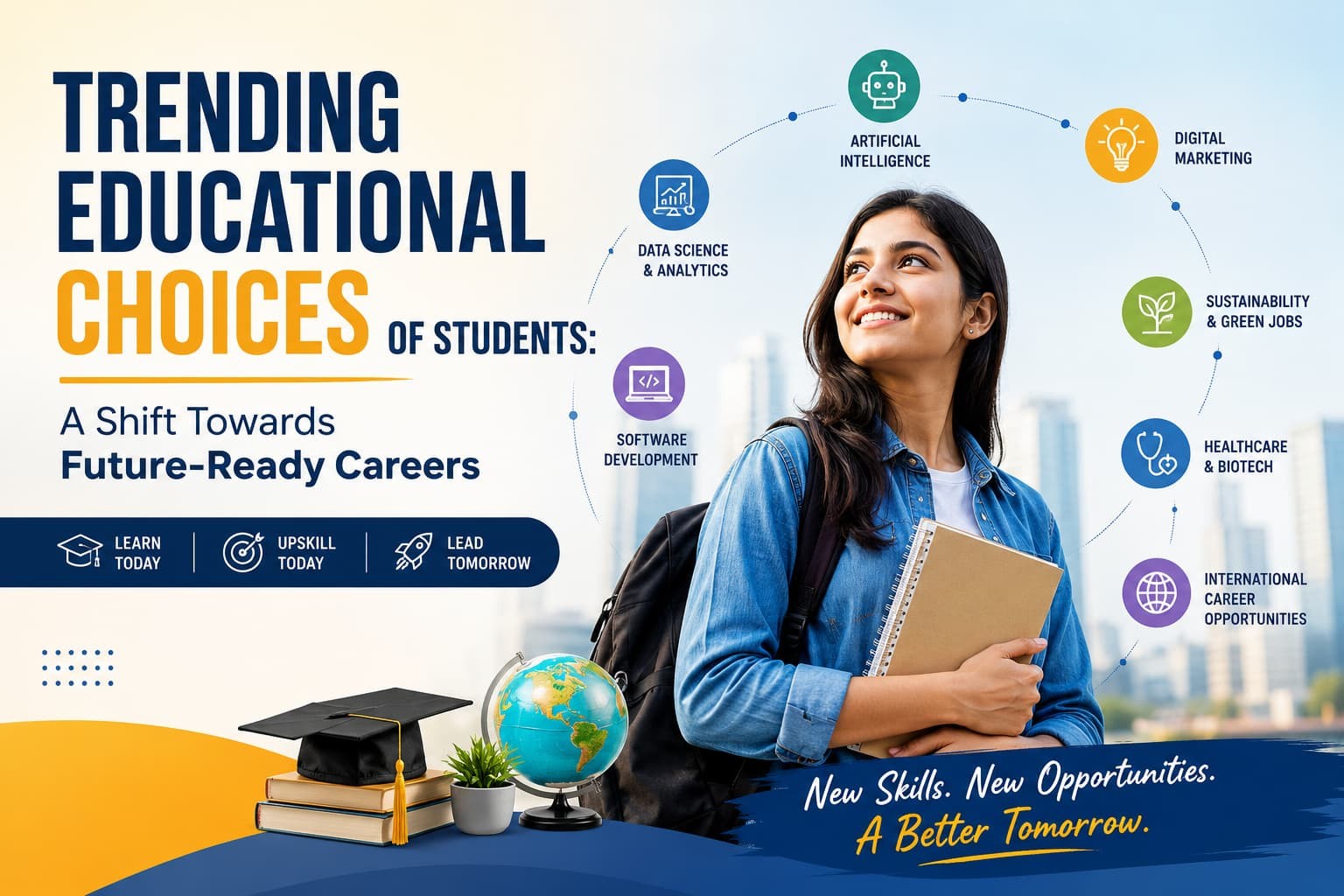
The educational choices of students are undergoing a remarkable transformation. For decades, students largely followed conventional academic pathways, often choosing courses based on family traditions, social perceptions, or established career routes. Today, however, the decision-making process has become far more strategic.
Modern students are asking practical questions before selecting a course or qualification. Will this programme lead to strong employment opportunities? Is the industry expected to grow in the future? Does the qualification offer global career prospects? Will the skills remain relevant in an increasingly technology-driven world?
These questions are influencing educational decisions like never before. Students are becoming more focused on employability, industry relevance, professional recognition, and future career security. As a result, educational trends are witnessing a significant shift away from purely traditional choices towards programmes that combine innovation, adaptability, and strong career outcomes.
Employability Is Driving Course Selection
One of the biggest factors influencing educational choices today is employability.
Students no longer view higher education solely as an academic achievement. They see it as an investment in their future. Consequently, they want programmes that provide practical skills, industry exposure, internship opportunities, and strong graduate employment outcomes.
Universities and educational institutions are also responding to this demand by designing programmes that align more closely with employer requirements. Courses that include industry projects, work placements, professional certifications, and experiential learning opportunities are becoming increasingly attractive.
The focus has shifted from simply earning a qualification to building a successful and sustainable career.
Students Are Moving Beyond Traditional Academic Boundaries
Another notable trend is the growing interest in interdisciplinary and multidisciplinary learning.
The modern workplace values professionals who can combine expertise from multiple fields. Employers increasingly seek individuals who understand technology, business, communication, creativity, and problem-solving simultaneously.
As a result, students are exploring programmes that blend different disciplines rather than restricting themselves to a single area of study.
For example:
- Business students are learning data analytics and artificial intelligence.
- Engineering students are studying entrepreneurship and management.
- Healthcare students are exploring digital health technologies.
- Computer science students are gaining knowledge in finance and business strategy.
- Psychology students are entering fields such as user experience design and behavioural analytics.
This flexibility enables graduates to adapt to changing job market demands and explore diverse career opportunities.
Which Courses Are Students Switching To?
One of the most interesting developments in recent years is the movement towards emerging and future-focused disciplines.
-
Artificial Intelligence and Machine Learning
Artificial Intelligence (AI) and Machine Learning (ML) have become some of the most sought-after fields globally. Students are attracted by the wide range of applications across healthcare, finance, education, manufacturing, and technology.
The growing adoption of AI across industries has significantly increased demand for professionals with expertise in this area.
-
Data Science and Business Analytics
Data is often described as the new currency of the digital economy. Organisations rely heavily on data-driven decision-making, creating strong demand for data scientists, analysts, and business intelligence professionals.
Students from engineering, mathematics, commerce, and even social science backgrounds are increasingly moving into data-related disciplines.
-
Cybersecurity
With cyber threats becoming more sophisticated, organisations require skilled professionals to protect digital infrastructure and sensitive information.
Cybersecurity has emerged as a highly attractive field due to strong employment prospects and global demand.
-
FinTech and Financial Technology
The financial services sector is undergoing rapid digital transformation. Students interested in finance are increasingly exploring FinTech programmes that combine financial knowledge with technology, innovation, and digital systems.
-
Digital Marketing
Traditional marketing has evolved significantly in the digital age. Students are choosing digital marketing because it combines creativity, technology, analytics, and business strategy.
The rapid growth of social media platforms, e-commerce, and digital advertising has expanded career opportunities in this field.
-
Sustainability and Environmental Management
Climate change and environmental responsibility have become global priorities. As governments and organisations invest in sustainable development initiatives, demand for professionals in environmental management, renewable energy, and sustainability is growing.
Students who want to contribute to meaningful global challenges are increasingly attracted to these disciplines.
-
Biotechnology and Life Sciences
Advancements in healthcare, pharmaceuticals, genetics, and medical research have renewed interest in biotechnology and life sciences.
These sectors continue to offer exciting opportunities for innovation and scientific advancement.
-
Healthcare and Allied Health Sciences
Healthcare remains one of the most stable and essential sectors globally. Students continue to pursue programmes related to healthcare, but many are now exploring specialised areas such as healthcare management, public health, health informatics, digital health, physiotherapy, occupational therapy, and advanced nursing pathways.
-
User Experience (UX) and Product Design
As organisations focus on improving customer experiences, demand for professionals who understand human behaviour, design thinking, and digital interaction continues to increase.
This has made UX design and product design attractive options for creatively inclined students.
Professional Qualifications Are Becoming More Popular
Alongside university degrees, students are increasingly pursuing professional qualifications that strengthen their employability.
Qualifications in accounting, finance, project management, risk management, technology, cybersecurity, and business operations are becoming popular because they provide specialised industry recognition and practical expertise.
Many students now view professional certifications as a valuable complement to their academic qualifications.
Soft Skills Matter More Than Ever
Employers today are not only looking for technical knowledge. They also seek graduates who possess strong communication skills, adaptability, leadership abilities, critical thinking, teamwork, and emotional intelligence.
Students are therefore choosing programmes that provide opportunities for practical learning, collaboration, presentations, and real-world problem-solving.
The ability to continuously learn and adapt has become one of the most important skills in the modern workforce.
The Rise of Lifelong Learning
Another major trend is the growing acceptance that education does not end after graduation.
Students increasingly understand that continuous upskilling and reskilling will be necessary throughout their careers. Online learning platforms, micro-credentials, short-term certifications, and specialised training programmes are becoming important components of professional development.
The concept of lifelong learning is now a reality rather than a future prediction.
What Does This Mean for Students Considering Study Abroad?
These changing educational trends are also influencing international education choices. Students exploring overseas education are no longer selecting destinations solely based on popularity. Instead, they are carefully evaluating which countries, universities, and programmes offer the strongest alignment with future industry demands.
Many international universities are at the forefront of delivering interdisciplinary learning, industry-integrated curricula, research-led education, and programmes in emerging fields such as Artificial Intelligence, Data Science, Cybersecurity, Sustainability, FinTech, and Digital Health.
For students planning to study abroad, the focus should not simply be on obtaining an international degree. The real objective should be choosing a programme that develops future-ready skills, enhances employability, and prepares them for long-term success in a rapidly evolving global workforce.
As educational choices continue to evolve, students who align their academic decisions with emerging industry trends and future career opportunities will be better positioned to thrive in the decades ahead.
With over 18 years in overseas education consulting, Edroots International has successfully facilitated admissions for 19,600+ students across universities worldwide. Book your free one-to-one counselling session today at 9349 555 333.

Enquiry Form